
HAIR AND SCALP CONCERN
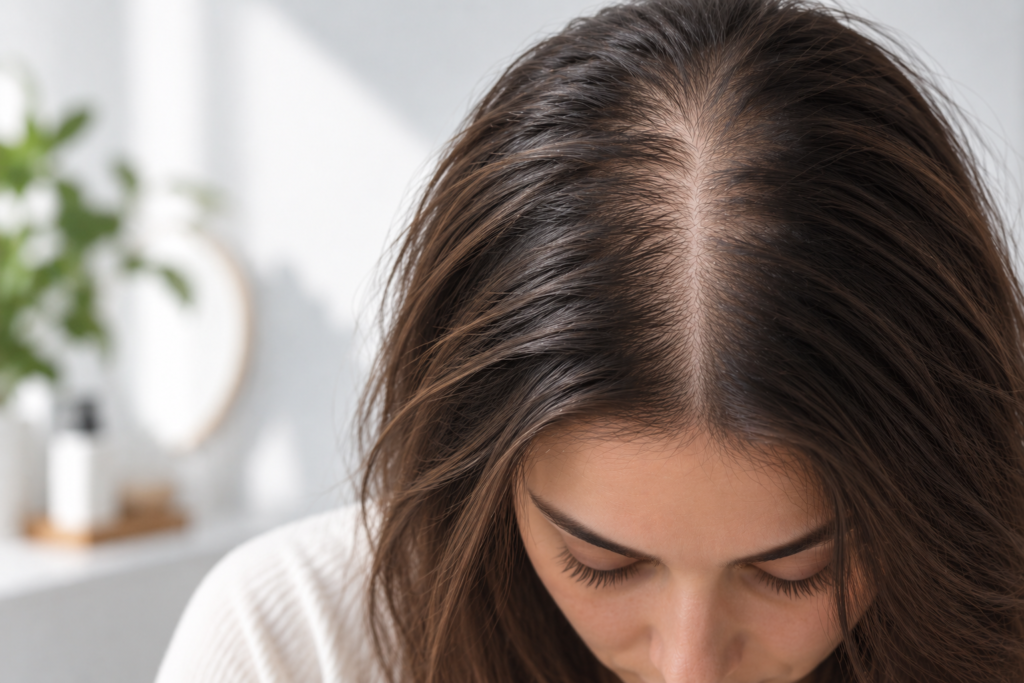
The part may appear broader or more scalp may be visible along it. Lighting, hairstyle and image angle can change appearance, so consistent comparison matters.
A ponytail, braid or overall hairstyle may feel less full than before. This is a subjective observation and does not identify the underlying process.
The scalp may become easier to see through the hair in a diffuse or patterned area. Distribution and progression are useful to document.
A gradual reduction in how full the hair looks may become noticeable over time. Comparing observations under similar lighting, styling and viewing conditions can help document change, but it cannot determine the underlying cause.
An illness, high fever, surgery, childbirth, major physiological or psychological stress, restrictive nutrition, medication change, or another relevant event may affect the hair cycle in some people.
The change in follicle cycling may occur before increased shedding becomes visible. The interval varies and does not establish the cause on its own.
In telogen effluvium, increased shedding may become noticeable months after a triggering event.
| Hair Thinning | Hair Shedding or Breakage | |
|---|---|---|
| Main observation | Reduced density or fullness, such as a wider-looking part or more visible scalp. | Shedding: more hairs being released. Breakage: shafts fracturing, often leaving shorter or variable-length hairs. |
| Time course | May be gradual or more noticeable over a shorter period; the time course does not establish the cause. | Shedding may rise over weeks or months. Breakage may follow repeated mechanical, heat or chemical stress, but overlap is possible. |
| What it can show | A change in appearance or perceived volume that is useful to document. | Clues about the process, but neither shed hairs nor broken hairs alone identify the cause. |
| What it cannot show | Visible or perceived thinning cannot identify the underlying cause or confirm a specific diagnosis. | Noticing increased shedding or broken hairs cannot by itself establish why the change is occurring or whether another process is also contributing. |
Important: These observations can overlap. A comparison can help you describe what you notice, but it cannot identify the underlying cause or diagnosis.

These factors may provide useful context, but none establishes the cause of hair shedding on its own.
Where thinning appears and how quickly it changes help organize the concern, but do not establish a diagnosis.
Current evidence supports
A diffuse, central, frontal, temporal or focal change—and whether it is gradual, rapid, stable or progressive—can guide evaluation. Appearance alone remains non-diagnostic.
Family history and life-stage context may be clinically relevant, but neither determines the cause by itself.
Current evidence suggests
Family history, puberty, pregnancy or postpartum changes, menopause, menstrual or androgen-related symptoms may be relevant context for a clinician.
Recent health events or systemic symptoms can matter when interpreted with the full history and examination.
Current evidence suggests
Illness, surgery, major weight change, restrictive intake, endocrine symptoms or other systemic changes may coexist with hair change. Thinning alone cannot establish a deficiency or disease.
Medication timing and relevant exposures belong in the history; a temporal association does not prove causation.
Current evidence supports
Document new medicines, dose changes, treatment exposures and their timing. Do not stop prescribed medication without discussing it with the prescriber.
Hair-shaft breakage can reduce apparent fullness and may coexist with follicular hair loss.
Current evidence supports
Traction, repeated heat, chemical processing and forceful handling may contribute to breakage or apparent density change. Their presence does not explain every thinning pattern.
A wider-looking part, reduced ponytail fullness or increased scalp visibility cannot by themselves identify androgenetic alopecia, a nutrient deficiency, a hormonal condition or any other diagnosis.
Hair thinning can reflect changes in hair number, shaft calibre, shedding, breakage, styling or more than one process at the same time. Pattern, time course, scalp findings, relevant history and—when indicated—professional examination are needed to interpret it.
The same visible reduction in fullness can arise from different or overlapping processes. A useful assessment considers where the change is occurring, how quickly it developed, whether shedding or breakage is also present, scalp symptoms, relevant life-stage or health context, medications and hair practices.
This context helps determine whether observation and documentation are reasonable or whether medical evaluation is appropriate. Visual or self-assessment alone cannot establish a diagnosis.
Perceived or visible loss of density can be described by distribution and time course, but diagnosis requires history and examination.
Gradual patterned thinning, diffuse increased shedding and hair-shaft breakage are distinct concepts that may overlap in the same person.
Family history, life-stage context, systemic history, medications and hair practices are relevant components of hair-loss assessment.
Focal loss, inflammatory scalp findings and possible loss of follicular openings require qualified evaluation because appearance alone cannot distinguish scarring from non-scarring processes.
A sudden or substantial reduction in density deserves timely assessment, especially when the pattern is unclear.
Discrete patches or sharply localized change should not be classified from appearance alone and may require professional examination.
Pain, burning, marked itch, redness, scale, pustules, crusting or drainage can indicate a scalp disorder that needs assessment.
A smooth or shiny area, loss of visible follicular openings or progressive change with inflammation warrants prompt dermatology evaluation because scarring processes can cause permanent loss.
Unexplained thinning that continues or worsens should be evaluated in the context of shedding, breakage, medical history and scalp findings.
Hair change accompanied by significant fatigue, unexplained weight change, menstrual or androgen-related symptoms, or other new systemic concerns should be discussed with a qualified clinician.
Start by documenting the location, distribution and time course with consistent photographs and brief notes. Record whether increased shedding, short broken hairs, scalp symptoms, recent health changes, medication changes or major life-stage events are also present.
Avoid introducing several supplements, products or procedures at the same time without a supported reason. Consider a qualified medical or dermatology assessment when thinning is rapid, marked, focal, symptomatic, unexplained, persistent or progressively worsening.
The NoviqCare Hair Check can help you organize observations about hair density, shedding, breakage and scalp context and consider an appropriate next step. It does not diagnose Hair Thinning or determine its cause.
Start Hair CheckNo. Hair thinning describes reduced density or fullness. Androgenetic alopecia is one possible diagnosis, but shedding disorders, breakage, scalp conditions and other contexts can produce or contribute to a similar appearance.
Thinning is a change in visible or perceived density. Shedding is increased release of hairs from follicles. Breakage is fracture of the formed hair shaft. They can occur separately or together, and self-inspection may not reliably distinguish them.
Seek qualified assessment for rapid or marked change, focal or patchy loss, pain or significant itch, redness, scale, pustules or crusting, possible scarring features, associated systemic symptoms, or unexplained thinning that persists or progresses.
NoviqCare provides evidence-informed education and decision support for hair and scalp concerns. It is not a medical clinic. It does not diagnose conditions, provide treatment or prescriptions, or offer professional medical advice, and it is not a substitute for care from a qualified healthcare professional. Using this site does not create a doctor–patient or other healthcare-provider relationship.
The information here, including anything produced by the NoviqCare assessment, is general and educational. It does not diagnose your condition, identify its cause, or tell you which treatment is right for you, and it may not apply to your individual circumstances.
Please speak with a physician, dermatologist, pharmacist, or other qualified healthcare professional about your own situation, including before starting, stopping, or changing any treatment.
If you have an urgent medical concern, or you think you may be experiencing a medical emergency, call 911 or your local emergency number, or contact a qualified healthcare professional immediately. Do not delay seeking care because of anything you have read here.
NoviqCare content is based on published research, professional guidance, and other reputable sources available at the time of writing. Understanding of hair and scalp health continues to develop, and our content is reviewed and updated as the evidence changes. Where the evidence is limited, uncertain, or mixed, we say so rather than overstate what is known.