
HAIR AND SCALP CONCERN
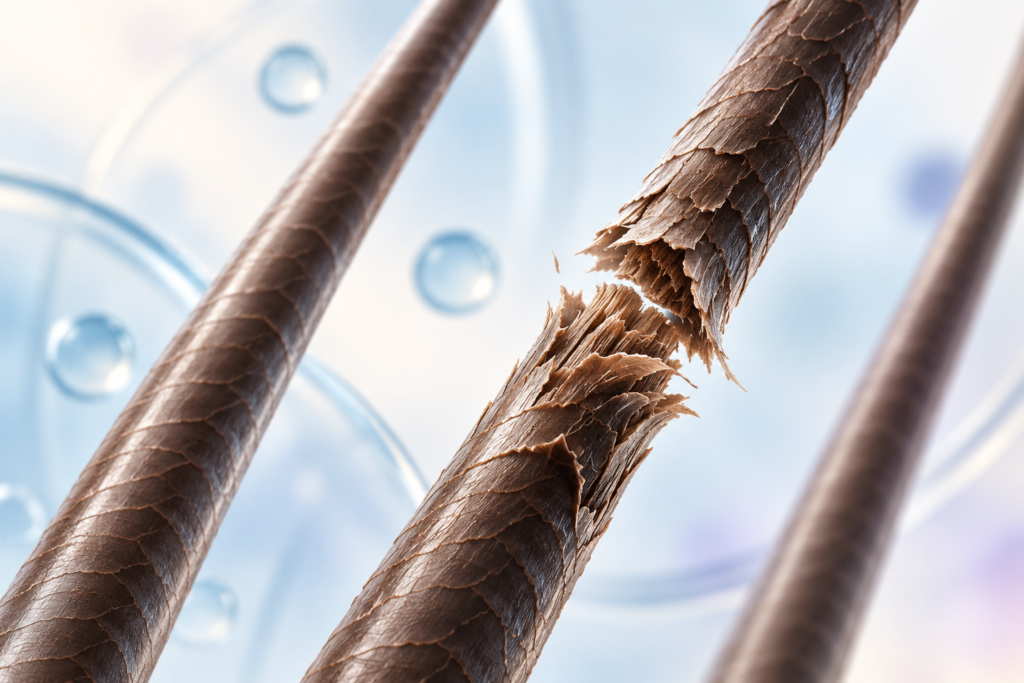
Hairs may appear noticeably shorter or different in length. This can be a clue to breakage, but short hairs may also represent new growth or occur with other conditions.
Fraying or splitting may occur when the cuticle and deeper shaft structure have weathered or become damaged.
The hair may feel rougher, less smooth or more difficult to manage. These changes are non-specific and do not establish the cause.
Hair may appear to fracture during handling or styling, especially when the shaft is already vulnerable.
An illness, high fever, surgery, childbirth, major physiological or psychological stress, restrictive nutrition, medication change, or another relevant event may affect the hair cycle in some people.
The change in follicle cycling may occur before increased shedding becomes visible. The interval varies and does not establish the cause on its own.
In telogen effluvium, increased shedding may become noticeable months after a triggering event.
| Hair Breakage | Hair Shedding | |
|---|---|---|
| What happens | The formed hair shaft fractures at a point along its length. | A hair is released from the follicle as part of the hair cycle. |
| What may be noticed | Shorter hairs, variable lengths, fraying or splitting may be present. | More full-length shed hairs may be noticed, but self-inspection is not definitive. |
| Density and scalp context | Breakage can reduce apparent length or volume. The scalp and follicles may be unaffected, or another process may coexist. | Increased shedding can affect perceived density. The pattern, scalp symptoms and wider context matter. |
| What appearance cannot establish | Appearance does not identify the damaging exposure or rule out a shaft, follicle or scalp condition. | Appearance does not identify the trigger or underlying diagnosis. |
| When assessment may help | Marked, unexplained, persistent, patchy or symptomatic breakage; progressive density loss; or possible scarring. | Persistent or worsening shedding, patchy loss, significant scalp symptoms or another concerning change. |
Important: These observations can overlap. A comparison can help you describe what you notice, but it cannot determine the cause.

These factors may provide useful context, but none establishes the cause of hair shedding on its own.
Repeated forceful manipulation, friction and traction may be relevant. Their presence does not prove that they caused the breakage.
Current evidence supports
Repeated forceful brushing, combing, manipulation or friction can contribute to weathering and fracture, particularly when a shaft is already vulnerable. Tight or heavy hairstyles can also place repeated tension on the hair and may affect both the shaft and follicles. Ordinary gentle grooming is not the same as repeated high-stress handling.
Thermal effects vary with temperature, duration, moisture, frequency, technique and the condition of the hair.
Current evidence supports
Repeated or excessive thermal exposure can damage the hair shaft. The evidence does not define one universal heat limit that applies to everyone.
Chemical effects vary by formulation, technique, repetition and the condition of the hair.
Current evidence supports
Bleaching, chemical straightening or relaxing, and permanent waving can alter the cuticle and cortex and may weaken the shaft. Repeated or combined processing can add to weathering over time. Colour processes are not all equivalent and should not be described as producing the same degree of damage in every person.
Susceptibility varies between individuals and should not be inferred from race or ethnicity.
Current evidence suggests
Previous weathering, fibre geometry, curvature and other individual hair properties may influence how mechanical stress is distributed along the shaft.
Hair breakage alone cannot show that someone has a nutrient deficiency, thyroid or other endocrine condition, systemic disease, or an inherited hair-shaft disorder. It also cannot identify the exact damaging exposure.
Those questions require appropriate context and, when indicated, professional assessment. Breakage alone is not a basis for choosing supplements, laboratory tests or medication changes.
Qualified assessment can help when breakage is marked or difficult to explain, persistent or worsening, patchy, accompanied by significant scalp symptoms, associated with progressive density loss or possible scarring, or continues despite reducing obvious high-stress exposures.
These features do not create an emergency rule or identify a diagnosis. They indicate that a closer history and examination may be useful.
Hair breakage is fracture of the formed shaft and is different from shedding a hair from the follicle.
Repeated mechanical stress, traction, excessive heat and some chemical processes can contribute to shaft weathering or damage.
The degree of damage varies with the exposure, technique, repetition and individual hair properties.
Short or variable-length hairs, fraying and texture changes can be useful observations, but they are not diagnostic.
A substantial or unexplained change may benefit from a closer history and examination.
Ongoing or worsening change may justify evaluation of other or coexisting causes. No fixed monitoring duration is implied.
Discrete patches or focal broken hairs have a broad differential and should not be diagnosed from appearance alone.
Significant scalp symptoms can indicate a process beyond isolated shaft weathering.
Progressive density reduction may involve a follicular process rather than breakage alone.
A scarring appearance or loss of follicular openings warrants prompt qualified evaluation.
Assessment may help when breakage continues despite reducing obvious high-stress grooming, heat or chemical exposures.
Unusually severe, recurrent or early-onset fragility may justify clinician-directed examination such as trichoscopy or microscopy.
Start by documenting what you notice: where the change appears, whether hairs seem shorter or uneven, whether density is changing, and whether scalp symptoms are present. Note relevant grooming, tension, heat and chemical-processing context.
Where reasonable, reduce obvious high-stress practices and use ordinary gentle hair and scalp care. Avoid making several rapid product, supplement or medication changes based on breakage alone. Seek qualified assessment when the pattern is unexplained, persistent, worsening, patchy or accompanied by significant scalp symptoms or density loss.
The NoviqCare Hair Check can help you organize observations about your hair and scalp and consider an appropriate next step. It does not diagnose Hair Breakage or determine its cause.
Start Hair CheckBreakage involves fracture along the shaft and may leave shorter or variable-length hairs. Shedding involves release of a hair from the follicle. These observations can overlap, and looking at the hair alone may not determine what is happening or why.
No. Nutritional and systemic conditions can sometimes affect hair, but breakage is non-specific. It cannot establish a nutrient deficiency, thyroid condition or other systemic cause on its own.
Products may temporarily improve the surface feel, smoothness or manageability of the formed hair fibre. They do not biologically heal all existing structural damage or identify why breakage occurred.
NoviqCare provides evidence-informed education and decision support for hair and scalp concerns. It is not a medical clinic. It does not diagnose conditions, provide treatment or prescriptions, or offer professional medical advice, and it is not a substitute for care from a qualified healthcare professional. Using this site does not create a doctor–patient or other healthcare-provider relationship.
The information here, including anything produced by the NoviqCare assessment, is general and educational. It does not diagnose your condition, identify its cause, or tell you which treatment is right for you, and it may not apply to your individual circumstances.
Please speak with a physician, dermatologist, pharmacist, or other qualified healthcare professional about your own situation, including before starting, stopping, or changing any treatment.
If you have an urgent medical concern, or you think you may be experiencing a medical emergency, call 911 or your local emergency number, or contact a qualified healthcare professional immediately. Do not delay seeking care because of anything you have read here.
NoviqCare content is based on published research, professional guidance, and other reputable sources available at the time of writing. Understanding of hair and scalp health continues to develop, and our content is reviewed and updated as the evidence changes. Where the evidence is limited, uncertain, or mixed, we say so rather than overstate what is known.