

Each hair follicle follows its own biological cycle rather than growing continuously. During this cycle, a hair grows, transitions, rests, and eventually sheds before a new growth cycle begins.
Scalp follicles cycle asynchronously: they do not all enter the same stage at the same time. At any given moment, some follicles are actively growing hair, some are transitioning, some are resting, and others are releasing an older hair. This independent timing helps explain why normal shedding can occur without all scalp hair being lost at once.
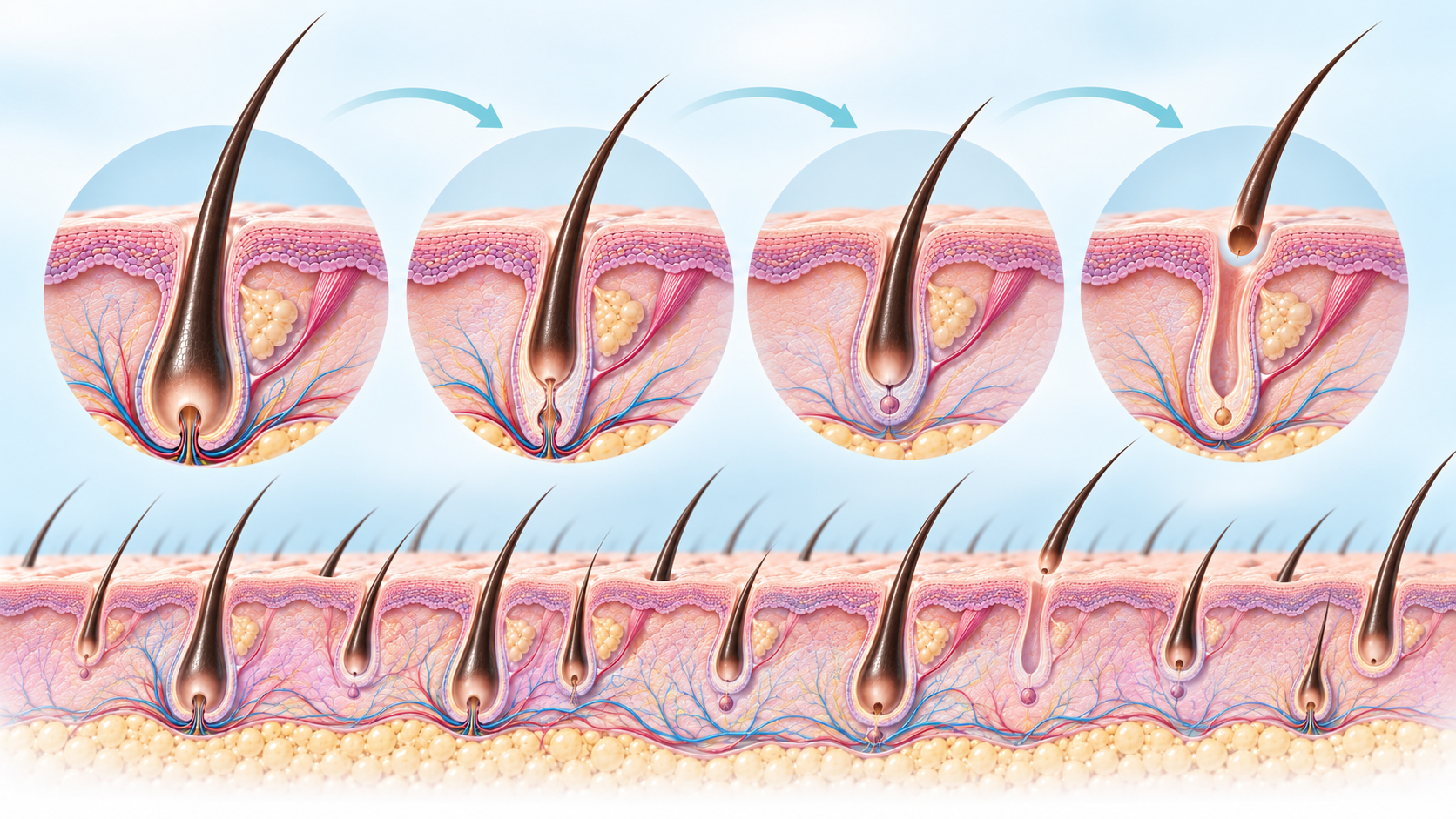
1. Anagen — Growth Phase
Anagen is the active growth stage. Cells in the follicle produce the hair shaft, allowing it to lengthen. Scalp follicles can remain in anagen for several years, although the duration varies between follicles and individuals.
2. Catagen — Transition Phase
Catagen is a brief transition phase in which active growth stops and the lower follicle regresses and remodels. This transition prepares the follicle to enter the resting phase.
3. Telogen — Resting Phase
During telogen, active hair-shaft growth pauses while the older hair remains in place. The follicle is not simply inactive; it remains part of an ongoing cycle and prepares for the next period of growth.
4. Exogen — Shedding Phase
Exogen is the stage when the older hair is released from the follicle. This shedding is a normal part of cycling. When a larger-than-usual proportion of follicles reaches the resting and shedding phases around the same time, the change can become more noticeable.
Some shedding is a normal result of the hair cycle. Because follicles cycle independently, older hairs are regularly released while other follicles remain in growth. Seeing shed hairs therefore does not automatically mean that growth has stopped or that permanent hair loss is occurring.
The useful comparison is not a rigid daily count, but whether the amount or pattern has changed from what is usual for that person. A noticeable change may provide context, but it cannot establish a cause by itself.
Hair shedding can become more noticeable when a larger-than-usual proportion of follicles moves toward the resting and shedding phases around the same time. This type of shift may follow illness, significant physiological or psychological stress, nutritional or hormonal changes, certain medication changes, or other factors relevant to the person’s context.
Hair-cycle changes are not always visible immediately. When increased shedding is associated with a triggering event, it may become noticeable months later because affected follicles move through the resting process before older hairs are released. The interval is not identical for every person or event, so timing should be treated as context rather than proof of causation.
Hair-cycle biology alone cannot determine whether an individual’s shedding is related to iron deficiency, thyroid disease, stress, medication, hormonal change, nutritional factors, or another condition. These possibilities cannot be confirmed from shedding or timing alone. Appropriate history, scalp assessment, and selected testing may be needed when further evaluation is indicated.
Understanding the cycle is useful for documenting when shedding became noticeable, whether the pattern has changed, and whether other signs are present. That information can support a more informed decision about whether continued observation or qualified professional assessment may be appropriate. It does not replace assessment or provide a diagnosis.