
HAIR & SCALP CONCERN
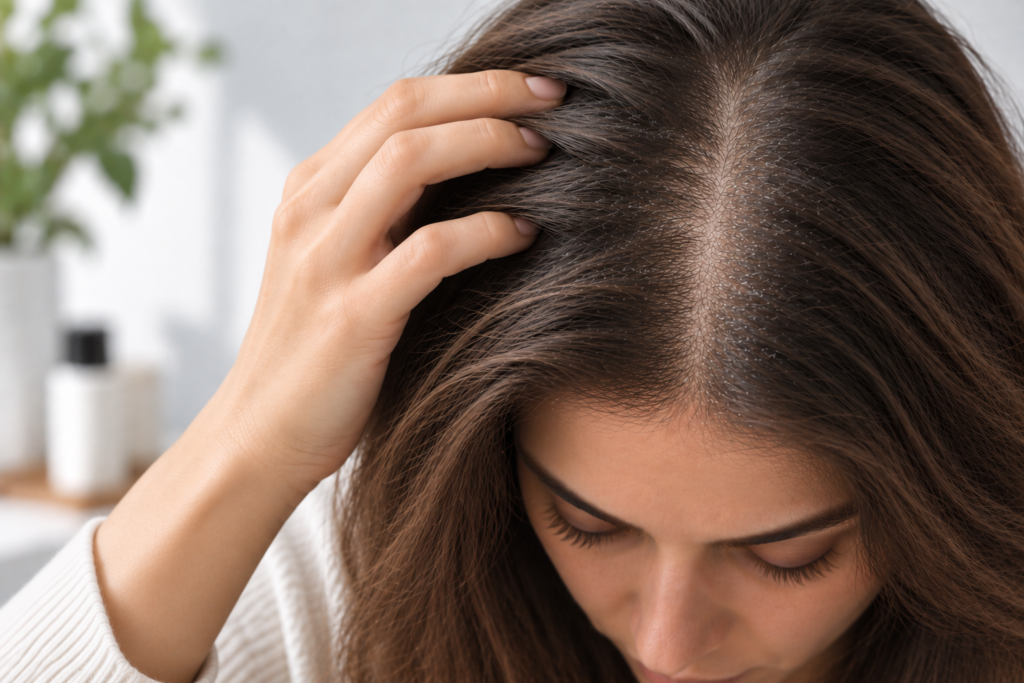
The scalp may feel tight, less comfortable or dry, including after cleansing or environmental exposure. This sensation is descriptive and does not confirm its cause.
Small visible flakes may occur, but flake size, colour or apparent oiliness cannot reliably distinguish dryness from dandruff or an inflammatory scalp condition.
The scalp may feel rough, itchy, tender or uncomfortable. Itching is non-specific and does not prove that dryness is responsible.
Symptoms may appear or worsen around cleansing, products, procedures, weather or low-humidity environments. Timing can guide assessment but does not prove individual causality.
An illness, high fever, surgery, childbirth, major physiological or psychological stress, restrictive nutrition, medication change, or another relevant event may affect the hair cycle in some people.
The change in follicle cycling may occur before increased shedding becomes visible. The interval varies and does not establish the cause on its own.
In telogen effluvium, increased shedding may become noticeable months after a triggering event.
| Dryness-Led Observations | Dandruff / Other Scaly Patterns | |
|---|---|---|
| Main experience | Tightness, roughness or a dry sensation may be prominent, with or without fine flaking. | Flaking and itch may be more prominent, but the appearance can still be dry, oily or mixed. |
| Visible findings | The scalp may look relatively normal or show fine scale; redness may be absent or present for another reason. | Scale may occur with or without redness, plaques, crusting or findings beyond the scalp, depending on the condition. |
| Context and course | Changes may be noticed after cleansing, product or procedure exposure, or in low-humidity or cold conditions. | Patterns may be recurrent, persistent or inflammatory and may involve seborrheic dermatitis, psoriasis, contact dermatitis or another cause. |
| What the pattern establishes | A dryness-led pattern does not by itself confirm xerosis, dehydration, low sebum or barrier damage. | Flakes, colour, size or apparent oiliness alone do not establish dandruff or a specific diagnosis. |
These patterns overlap and may coexist. They are prompts for observation, not a diagnostic test. History and examination may be needed to distinguish scalp xerosis from dandruff, dermatitis, psoriasis, infection or other scaly scalp disorders.
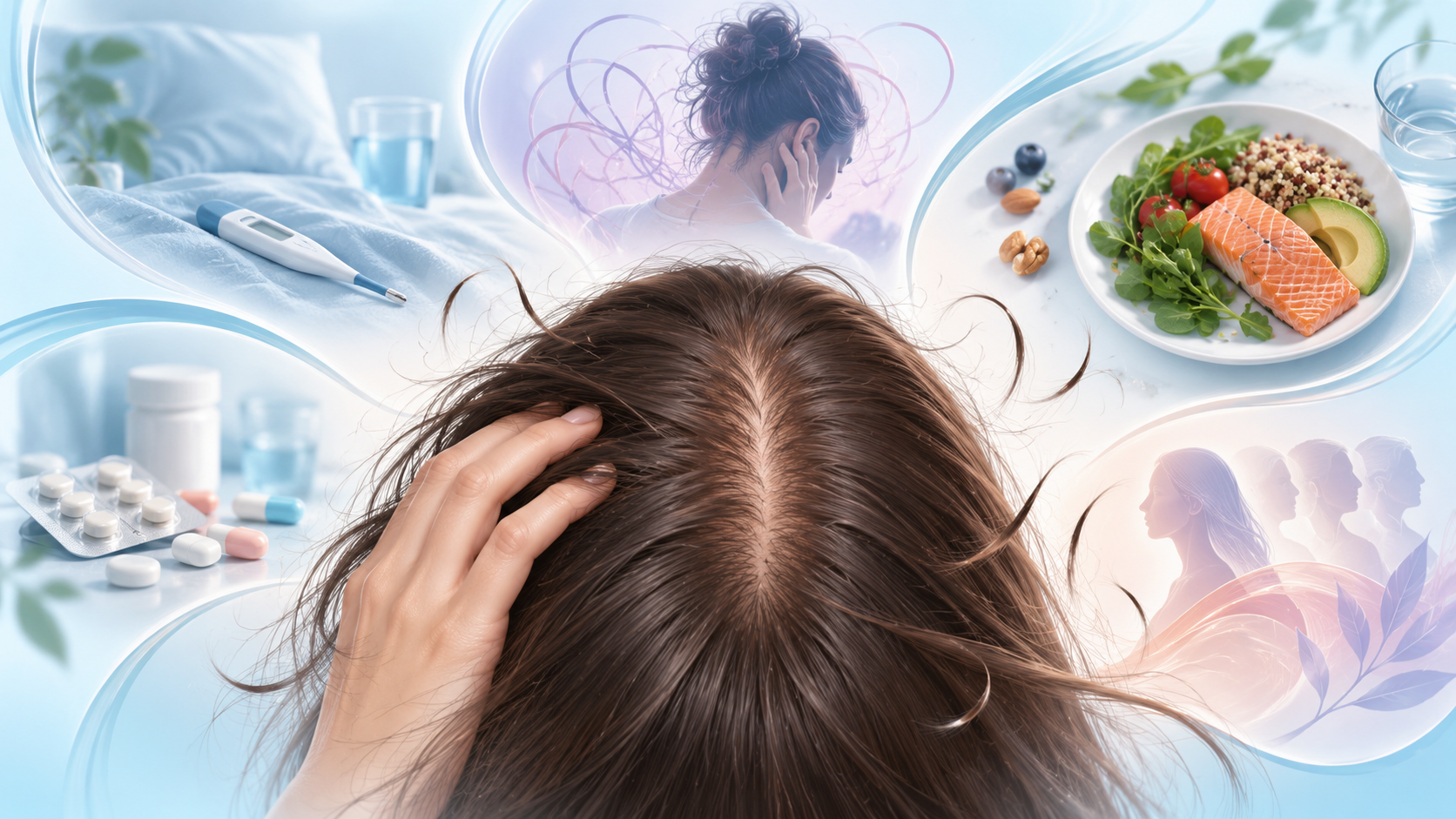
These factors may provide useful context, but none establishes the cause of hair shedding on its own.
Dry air and temperature-related exposure can influence skin water balance, although scalp-specific effects vary.
Current evidence supports
General xerosis literature supports low humidity, cold conditions and indoor heating as relevant dryness contexts. Applying this evidence to an individual scalp remains an inference, not proof of cause.
General skin evidence is stronger than scalp-specific evidence.
Washing practices and scalp-applied products can affect comfort and surface appearance.
Current evidence suggests
Frequent or intensive cleansing, heat, colouring, straightening and other scalp-applied products may coincide with dryness or irritation. A temporal association does not establish irritant or allergic contact dermatitis or identify a responsible ingredient.
Skin characteristics, atopic tendency, age and health context can influence susceptibility to xerosis or irritation.
Some evidence suggests
Dryness involves stratum-corneum water and lipid processes, and general skin evidence shows variation with age and individual characteristics. Symptoms alone cannot demonstrate barrier dysfunction or a medical cause on the scalp.
Evidence is largely extrapolated from non-scalp xerosis research.
Several scalp disorders can resemble or coexist with perceived dryness.
Current evidence supports
Dandruff, seborrheic dermatitis, psoriasis, contact dermatitis and other disorders may produce flaking, itching or discomfort. Distribution, inflammation, time course and examination help distinguish them.
Perceived dryness or flaking alone cannot confirm xerosis as the exact diagnosis, dandruff, seborrheic dermatitis, psoriasis, allergic or irritant contact dermatitis, infection, barrier damage, dehydration or an exact product cause. These possibilities can overlap in appearance, and the absence of obvious redness does not make the experience unreal or unimportant.
Professional assessment can consider the type and distribution of symptoms, the amount and character of scale, redness or other inflammation, time course, cleansing and product or procedure exposures, environmental context, associated hair loss, findings elsewhere on the skin, and relevant health or medication context. This helps distinguish overlapping possibilities without treating any single symptom or flake pattern as diagnostic.
Dry skin/xerosis involves stratum-corneum water balance and barrier-related processes, but these mechanisms cannot be inferred in an individual scalp from symptoms or appearance alone.
Environmental conditions and cleansing or exposure context can influence dryness and irritation, although scalp-specific evidence is more limited than general skin evidence.
Scalp flaking and itching are non-specific observations that may occur with dandruff, seborrheic dermatitis, psoriasis, contact dermatitis and other conditions.
Persistent or problematic scalp dryness, scale, inflammation, discomfort or hair loss is best interpreted through history and clinical examination rather than appearance alone.
Seek prompt assessment for marked or persistent redness, swelling, significant pain or burning, cracking, blistering, oozing, crusting or drainage, because these findings may reflect inflammation, contact dermatitis, infection or another condition requiring evaluation.
Seek prompt assessment when scale is thick or extensive, symptoms are accompanied by hair loss, broken hairs, smooth or shiny areas, or possible scarring, or findings extend beyond the scalp.
Seek prompt assessment for significant or persistent burning, swelling, rash, blistering, oozing or worsening after a product or procedure. If the suspected exposure is a non-essential cosmetic product or procedure, avoid further exposure while seeking appropriate assessment. Do not stop or change prescribed or medically necessary treatment without contacting the prescribing clinician or appropriate healthcare professional.
Routine professional assessment may be appropriate when dryness, itching or flaking persists, repeatedly returns, remains unexplained, affects daily comfort, or does not improve with ordinary gentle care.
Document the pattern, time course, distribution and any associated redness, discomfort, scale or hair loss. Note cleansing, products, procedures and environmental context, and avoid changing several products at once because that can make the pattern harder to interpret.
For a non-essential cosmetic product or procedure that clearly seems to aggravate symptoms, avoiding repeated exposure may help clarify the pattern. Do not stop or change prescribed or medically necessary treatment without contacting the prescribing clinician or appropriate healthcare professional.
Ordinary gentle scalp care may be reasonable while monitoring mild symptoms, but persistent, inflammatory, painful, extensive or unexplained symptoms—or symptoms associated with hair loss—warrant professional assessment. This guidance does not prescribe a medicated shampoo, steroid, antifungal, oil, moisturizer, supplement or individualized washing schedule.
Answer a structured set of questions about your hair, scalp, and general history. NoviqCare organizes evidence-informed information around your answers to help you understand what may be relevant and what to discuss with a healthcare professional. This is an educational tool, not a diagnostic test, and it does not replace professional medical care.
Start the guided assessmentNo. Dryness and dandruff can share flaking, itching and discomfort, and dandruff scale can appear dry or oily. Other inflammatory or scaly conditions may look similar. Flakes alone cannot identify the cause, and the conditions may coexist.
Not necessarily. A dry or tight scalp does not establish systemic dehydration. Skin water balance, environment, cleansing, products, inflammation and individual characteristics can all be relevant, and drinking more water is not a universal treatment for unexplained scalp dryness.
Assessment is appropriate when symptoms are persistent, recurrent, painful, significantly inflamed, extensive, associated with thick scale or hair loss, extend beyond the scalp, or follow a product or procedure with burning, swelling, blistering, oozing or worsening.
NoviqCare provides evidence-informed education and decision support for hair and scalp concerns. It is not a medical clinic. It does not diagnose conditions, provide treatment or prescriptions, or offer professional medical advice, and it is not a substitute for care from a qualified healthcare professional. Using this site does not create a doctor–patient or other healthcare-provider relationship.
The information here, including anything produced by the NoviqCare assessment, is general and educational. It does not diagnose your condition, identify its cause, or tell you which treatment is right for you, and it may not apply to your individual circumstances.
Please speak with a physician, dermatologist, pharmacist, or other qualified healthcare professional about your own situation, including before starting, stopping, or changing any treatment.
If you have an urgent medical concern, or you think you may be experiencing a medical emergency, call 911 or your local emergency number, or contact a qualified healthcare professional immediately. Do not delay seeking care because of anything you have read here.
NoviqCare content is based on published research, professional guidance, and other reputable sources available at the time of writing. Understanding of hair and scalp health continues to develop, and our content is reviewed and updated as the evidence changes. Where the evidence is limited, uncertain, or mixed, we say so rather than overstate what is known.