
HAIR AND SCALP CONCERN
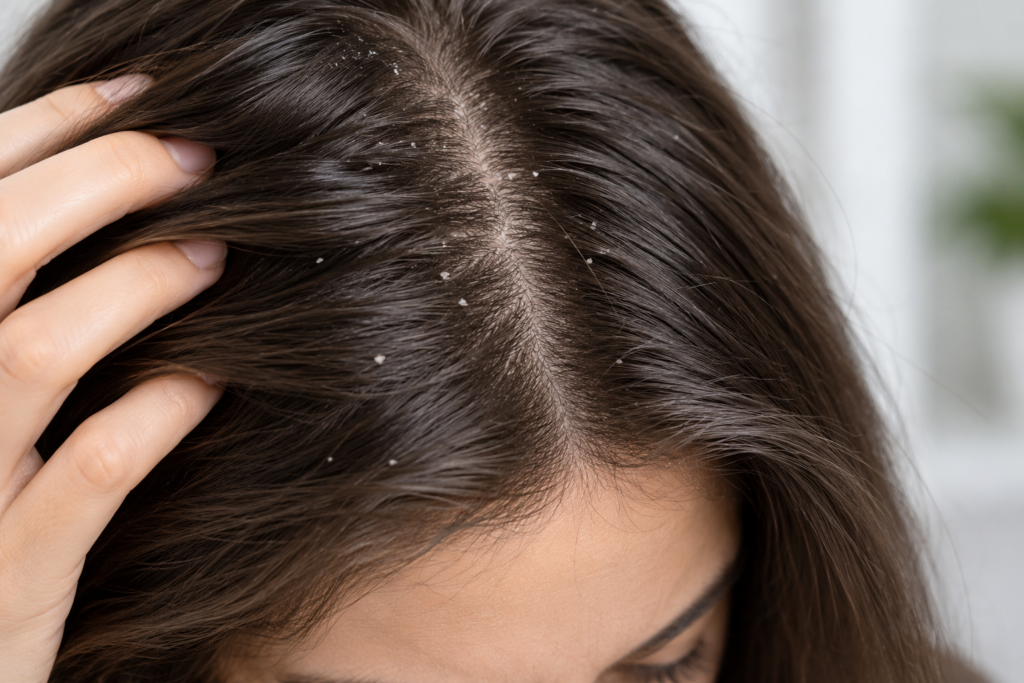
Loose or adherent flakes may be noticed on the scalp, hair or clothing. Their colour and size do not identify the underlying cause.
Some people notice itch, tightness or discomfort with flaking. The intensity varies and does not by itself distinguish dandruff from another scalp condition.
Flaking may improve and return or vary over time. Timing, distribution and recent changes can be useful context.
Redness or irritation may accompany flaking, but marked inflammation can also occur with other scalp disorders and may warrant assessment.
An illness, high fever, surgery, childbirth, major physiological or psychological stress, restrictive nutrition, medication change, or another relevant event may affect the hair cycle in some people.
The change in follicle cycling may occur before increased shedding becomes visible. The interval varies and does not establish the cause on its own.
In telogen effluvium, increased shedding may become noticeable months after a triggering event.
| Dandruff | Dryness or Other Scalp Flaking | |
|---|---|---|
| Main observation | Usually described as visible scalp flakes, sometimes with itch or discomfort. | Dry-looking scale can reflect xerosis, while similar scale may also occur with inflammatory, contact-related or infectious conditions. |
| Inflammation and distribution | May occur with little visible inflammation or as part of a more inflammatory seborrheic pattern. | Redness, thick scale or involvement beyond the scalp may provide useful context but still requires interpretation. |
| Context and time course | Can recur or fluctuate and may be influenced by several interacting scalp and personal factors. | Product changes, environmental conditions, other skin involvement and symptom duration may help frame the pattern. |
| What appearance cannot show | Flake colour, size or greasiness cannot confirm the cause or establish a diagnosis. | Visual appearance alone cannot reliably separate dry scalp, seborrheic dermatitis, psoriasis, contact dermatitis or infection. |
Important: These patterns may overlap. This comparison can help describe what you notice, but it cannot diagnose dandruff, dry scalp, seborrheic dermatitis, psoriasis, contact dermatitis, infection or another scalp condition.
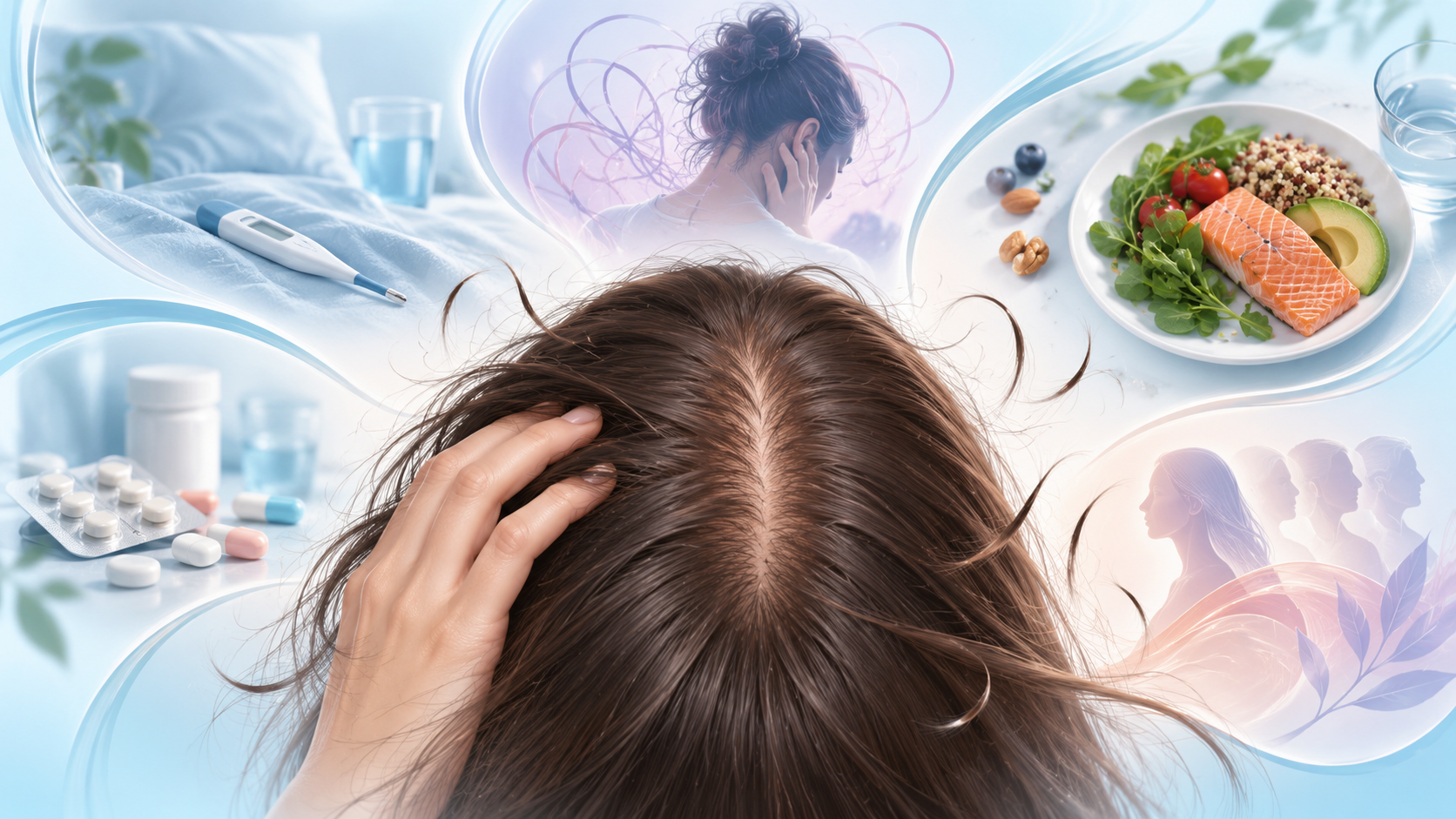
These factors may provide useful context, but none establishes the cause of hair shedding on its own.
Malassezia and the scalp's lipid environment are relevant to dandruff, but neither alone establishes an individual's cause.
Current evidence supports
Malassezia species normally colonize human skin. Their interaction with scalp lipids is associated with dandruff and seborrheic dermatitis, but this is not equivalent to a simple infection or a universal explanation.
Differences in skin-barrier function and inflammatory response may help explain why similar scalp environments produce different symptoms.
Current evidence suggests
Individual barrier integrity and immune or inflammatory responses appear to influence susceptibility and symptom intensity. These mechanisms vary and cannot be inferred from flakes alone.
Product exposure and scalp-care changes can alter irritation or flake visibility without implying blame or poor hygiene.
Current evidence suggests
A new dye, spray, gel, shampoo or multiple simultaneous routine changes may contribute to irritation or overlap with contact dermatitis. Timing is useful context, not a diagnosis.
Recurrence, season, stress and overlap with other inflammatory scalp disorders can shape the observed pattern.
Some evidence suggests
Symptoms may fluctuate with environmental or personal context, while psoriasis, eczema and contact dermatitis can produce overlapping scale. The pattern supports assessment rather than self-diagnosis.
Visible scalp flakes alone cannot confirm seborrheic dermatitis, dry scalp, psoriasis, a fungal infection, contact dermatitis or poor hygiene.
Dandruff and seborrheic dermatitis are often described along a related spectrum, but the degree of inflammation, distribution and clinical context matter. Flake colour, size or an oily or dry appearance cannot reliably identify the cause without considering the full history and scalp examination.
Professional assessment may consider the distribution and character of scale, visible inflammation, itch or discomfort, recurrence and time course, involvement beyond the scalp, product or exposure history and signs suggesting another inflammatory or infectious disorder.
These features are interpreted together. No single observation, including flake colour or oiliness, can establish the diagnosis.
Dandruff is a common scalp-flaking disorder that may be accompanied by itch or discomfort and is often described at the milder scalp end of a spectrum related to seborrheic dermatitis.
Malassezia species are associated with dandruff and seborrheic conditions, but they are also normal skin inhabitants; their presence alone does not establish infection or fully explain symptoms.
Sebaceous activity, individual susceptibility, skin-barrier response and microbial interactions may all contribute, supporting a multifactorial rather than single-cause model.
Persistent or inflammatory scalp flaking can overlap with other disorders, so history and clinical examination are important when the pattern is marked, recurrent or uncertain.
Marked redness, swelling, tenderness, pain, crusting or drainage may indicate another condition or infection and warrants timely professional assessment.
Flaking accompanied by patchy hair loss, many broken hairs or areas that appear smooth or scar-like should be assessed rather than attributed to dandruff alone.
Thick scale, widespread involvement or similar changes on the face or body may reflect an overlapping inflammatory disorder and merits medical evaluation.
Flaking that persists, repeatedly returns, affects daily comfort or remains difficult to distinguish from another scalp problem is appropriate for routine professional evaluation.
Start by documenting where and when flaking occurs, whether itch, redness, pain, crusting or hair loss is present, and whether symptoms changed after a new product or scalp-care routine. Avoid changing several products at once, and use gentle scalp care while observing the pattern.
Consider qualified medical or dermatology assessment when flaking is persistent, recurrent, marked, painful, inflammatory, extensive, associated with hair loss or remains uncertain. This Concern does not provide a medication or treatment protocol.
Use the Hair Check to organize your observations and identify useful context for a more informed conversation. It does not diagnose dandruff or another scalp condition.
Start Hair CheckNo. Dandruff and dryness can both produce visible flakes, but similar-looking scale can also occur with seborrheic dermatitis, psoriasis, contact reactions and other scalp conditions. Appearance alone cannot establish the cause.
No. Malassezia yeasts are associated with dandruff and seborrheic conditions, but they normally live on human skin. Dandruff reflects interactions among the scalp environment, skin barrier, host response and microorganisms rather than proof of a simple fungal infection.
Consider professional evaluation when flaking is persistent or recurrent, markedly red or inflamed, painful, crusted or draining, extends beyond the scalp, occurs with hair loss, or remains uncertain despite reasonable gentle scalp care.
NoviqCare provides evidence-informed education and decision support for hair and scalp concerns. It is not a medical clinic. It does not diagnose conditions, provide treatment or prescriptions, or offer professional medical advice, and it is not a substitute for care from a qualified healthcare professional. Using this site does not create a doctor–patient or other healthcare-provider relationship.
The information here, including anything produced by the NoviqCare assessment, is general and educational. It does not diagnose your condition, identify its cause, or tell you which treatment is right for you, and it may not apply to your individual circumstances.
Please speak with a physician, dermatologist, pharmacist, or other qualified healthcare professional about your own situation, including before starting, stopping, or changing any treatment.
If you have an urgent medical concern, or you think you may be experiencing a medical emergency, call 911 or your local emergency number, or contact a qualified healthcare professional immediately. Do not delay seeking care because of anything you have read here.
NoviqCare content is based on published research, professional guidance, and other reputable sources available at the time of writing. Understanding of hair and scalp health continues to develop, and our content is reviewed and updated as the evidence changes. Where the evidence is limited, uncertain, or mixed, we say so rather than overstate what is known.