
HAIR AND SCALP CONCERN
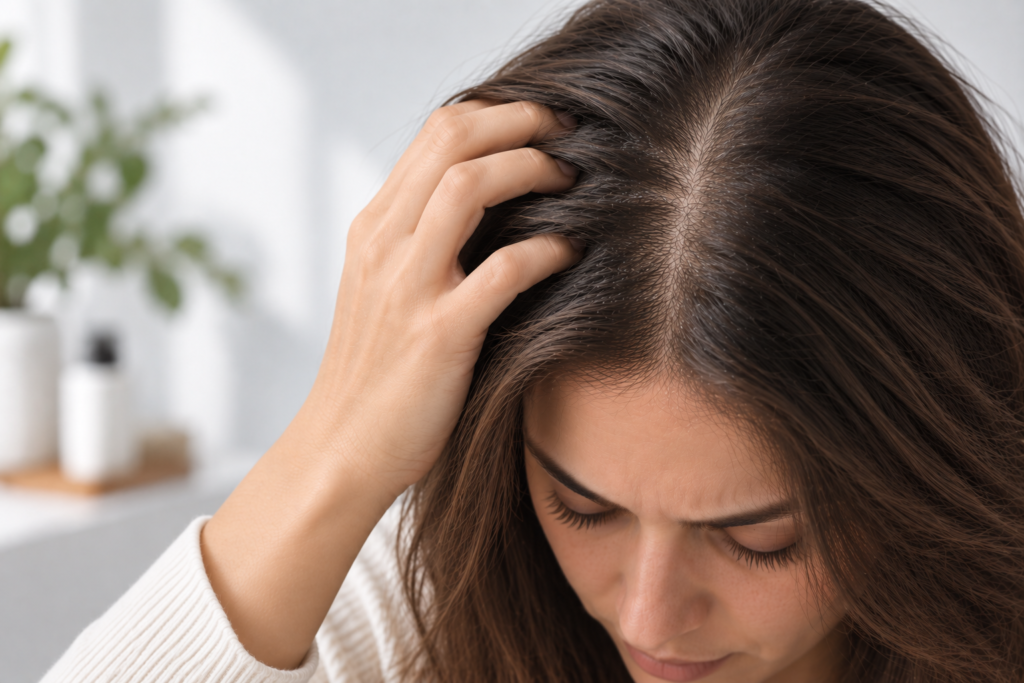
Warmth, burning, prickling or stinging may be felt in one area or across the scalp, with or without visible redness.
Itch or a tight, uncomfortable feeling may recur, but these sensations do not identify a specific scalp disorder.
The scalp may feel tender when touched, brushed or when hair is moved; tenderness remains a symptom rather than a diagnosis.
Symptoms may be noticed after a product, cleansing step, chemical service, heat or another exposure. Timing can guide assessment but does not prove causation.
An illness, high fever, surgery, childbirth, major physiological or psychological stress, restrictive nutrition, medication change, or another relevant event may affect the hair cycle in some people.
The change in follicle cycling may occur before increased shedding becomes visible. The interval varies and does not establish the cause on its own.
In telogen effluvium, increased shedding may become noticeable months after a triggering event.
| Sensitive Scalp Observations | Symptoms with Visible Scalp Changes | |
|---|---|---|
| What may be noticed | Burning, stinging, itching, tightness or tenderness may be the main observation. | Similar sensations may occur together with redness, scale, swelling, bumps, crusting or other visible change. |
| Timing and exposure context | Symptoms may fluctuate or follow a product, procedure, washing pattern, heat or environmental exposure. | Visible change after an exposure can strengthen the history but still does not establish the exact cause. |
| Visible findings | The scalp may look normal or show only subtle change. | Objective findings broaden the differential and may help a clinician select examination or testing. |
| What observation cannot show | Sensations alone cannot identify allergy, inflammation, infection, barrier damage or a sensory disorder. | Visible findings still require context and do not automatically identify one diagnosis or responsible ingredient. |
Important: Sensitive sensations and visible scalp disease can coexist. This comparison helps organize observations; it cannot diagnose contact dermatitis, seborrheic dermatitis, psoriasis, infection or another condition.
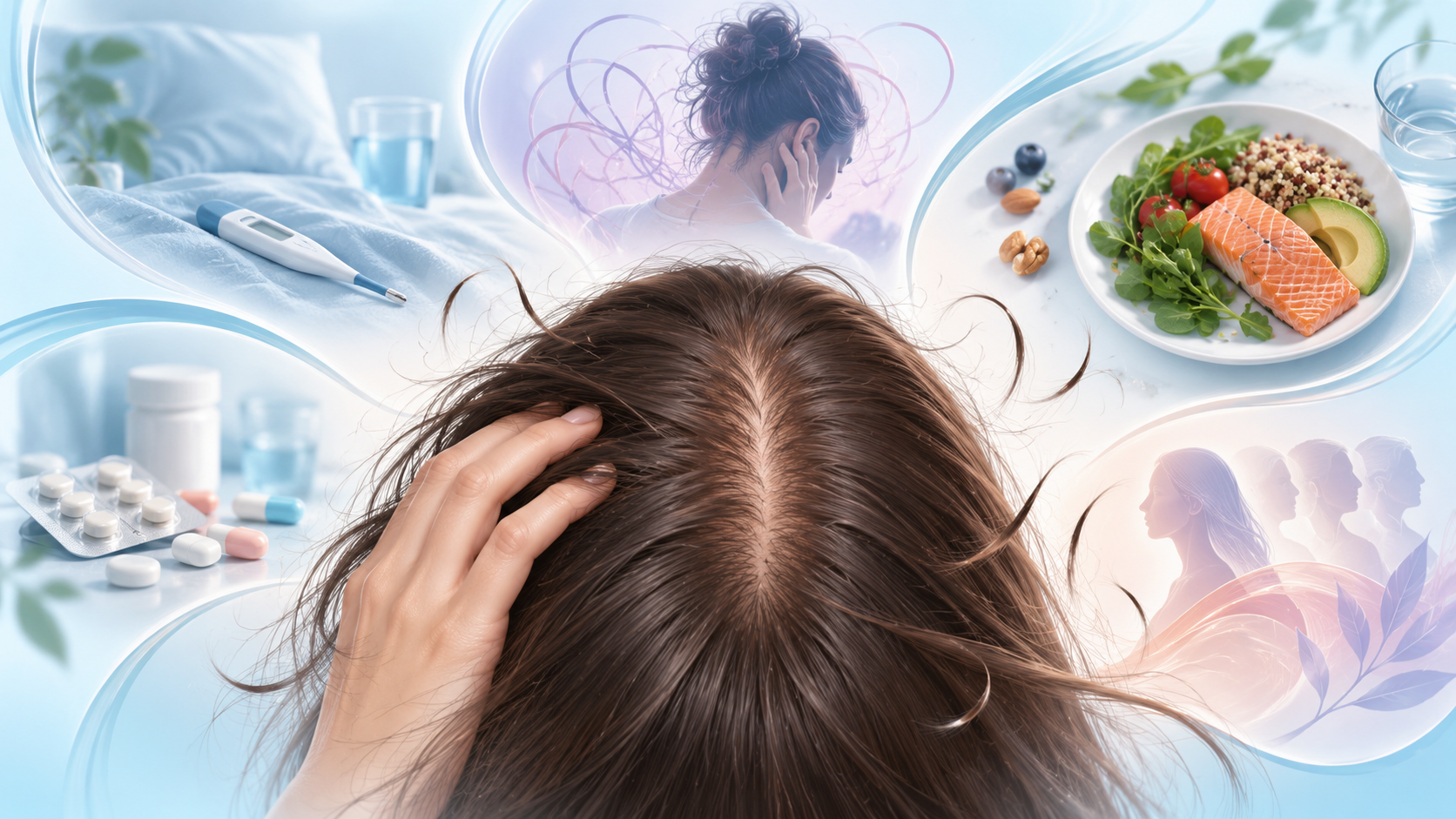
These factors may provide useful context, but none establishes the cause of hair shedding on its own.
Products and salon or styling procedures can provide useful timing clues, but an exposure history does not identify irritation, allergy or one causal ingredient.
Current evidence suggests
Record what was used, where it contacted the scalp, symptom timing and whether the pattern recurred. Association is a clue, not proof of allergy or causation.
Do not use symptom timing alone to label a product allergy.
Temperature, weather, washing and styling routines may change symptom context without proving a single mechanism.
Current evidence suggests
Environmental and routine factors are reported triggers in sensitive-scalp literature, but individual responses vary and universal rules are not established.
Context tracking is more informative than assuming one universally correct routine.
Common scalp disorders can include similar sensations and may coexist with a sensitive-scalp complaint.
Current evidence supports
Redness, scale, swelling, crusting, pustules or other findings can change the clinical context. Sensitive scalp alone cannot confirm or exclude these conditions.
Visible inflammatory change or progression warrants appropriate medical evaluation.
Neurosensory mechanisms and scalp dysesthesia are part of the differential when symptoms persist, especially when examination findings are limited.
Some evidence suggests
Burning, stinging, itch or pain without clear visible findings may have a sensory or neuropathic context, but proposed mechanisms remain uncertain and require clinical assessment.
Symptoms are valid even when visible findings are minimal; mechanism should not be presumed.
Sensitive scalp sensations alone cannot establish allergy or contact dermatitis, seborrheic dermatitis, psoriasis, infection, a damaged skin barrier, a neuropathic disorder, or one responsible product or ingredient. Burning, stinging, itching, tightness and tenderness overlap across multiple scalp conditions and may occur with limited or no visible findings, so the pattern requires clinical context rather than a single-cause assumption.
Assessment helps separate a non-specific symptom cluster from the conditions that can produce it. Useful context includes the quality and location of the sensation; onset, duration and recurrence; recent products, dyes, bleach, chemical services, heat or styling; washing routine; visible redness, scale, swelling, bumps, crusting or drainage; and any associated hair shedding or loss. Examination can then guide whether dermatologic evaluation, exposure review, patch testing or another pathway is appropriate.
Published descriptions consistently frame sensitive scalp as a subjective symptom cluster that can include burning, stinging, itching, pain, prickling, tightness or tenderness.
Sensitive scalp symptoms may be reported with few or no objective examination findings, although visible erythema, scaling or another scalp disorder can coexist.
Cosmetic products, cleansing, heat, environmental conditions and procedures are reported as possible triggers or contexts, but an association does not identify a specific mechanism or culprit.
Persistent symptoms, visible inflammation, marked pain or accompanying hair loss warrant history and scalp examination because the symptom cluster overlaps with dermatologic and sensory conditions.
Prompt assessment can help identify contact reactions, inflammatory disease or infection and guide appropriate care.
If the suspected exposure is a non-essential cosmetic product or procedure, avoid further exposure while seeking appropriate assessment. Do not stop or change prescribed or medically necessary treatment without contacting the prescribing clinician or appropriate healthcare professional. Seek prompt clinical advice, particularly when symptoms are intense, worsening or accompanied by visible change.
Shedding, patchy loss, broken hairs or other hair change alongside scalp symptoms broadens the differential and merits timely assessment.
Routine evaluation is reasonable when burning, stinging, itching, tightness or tenderness keeps returning, affects daily life or occurs without a clear visible explanation.
Until the pattern is clearer, a conservative approach may include avoiding repeated scratching and unnecessary harsh treatments, and recording symptoms alongside exposures and visible changes. For a recently introduced non-essential cosmetic product or procedure that clearly seems to aggravate symptoms, pausing that exposure may help clarify the pattern. Do not stop or change prescribed or medically necessary treatment without contacting the prescribing clinician or appropriate healthcare professional. Product labels such as “natural,” “gentle” or “hypoallergenic” do not guarantee individual tolerability. Persistent, progressive, painful or visibly inflamed symptoms should be assessed rather than repeatedly self-treating an assumed cause.
Answer a structured set of questions about your hair, scalp, and general history. NoviqCare organizes evidence-informed information around your answers to help you understand what may be relevant and what to discuss with a healthcare professional. This is an educational tool, not a diagnostic test, and it does not replace professional medical care.
Start the guided assessmentYes. Sensitive-scalp and scalp-dysesthesia literature describe burning, stinging, itching, tightness or tenderness with limited or no obvious examination findings. A normal-looking scalp does not invalidate the symptom, but it also does not reveal the cause.
No. Allergy is one possibility, but the same sensations can occur with irritation, inflammatory scalp conditions or sensory dysesthesia. Timing and distribution can guide evaluation; they cannot confirm an allergen without appropriate clinical assessment.
Assessment is appropriate when symptoms persist or recur, are significantly painful, follow a chemical exposure, occur with marked redness, swelling, blistering, oozing, crusting or drainage, or accompany hair shedding or loss.
NoviqCare provides evidence-informed education and decision support for hair and scalp concerns. It is not a medical clinic. It does not diagnose conditions, provide treatment or prescriptions, or offer professional medical advice, and it is not a substitute for care from a qualified healthcare professional. Using this site does not create a doctor–patient or other healthcare-provider relationship.
The information here, including anything produced by the NoviqCare assessment, is general and educational. It does not diagnose your condition, identify its cause, or tell you which treatment is right for you, and it may not apply to your individual circumstances.
Please speak with a physician, dermatologist, pharmacist, or other qualified healthcare professional about your own situation, including before starting, stopping, or changing any treatment.
If you have an urgent medical concern, or you think you may be experiencing a medical emergency, call 911 or your local emergency number, or contact a qualified healthcare professional immediately. Do not delay seeking care because of anything you have read here.
NoviqCare content is based on published research, professional guidance, and other reputable sources available at the time of writing. Understanding of hair and scalp health continues to develop, and our content is reviewed and updated as the evidence changes. Where the evidence is limited, uncertain, or mixed, we say so rather than overstate what is known.