

Minoxidil

What Minoxidil Is

Topical minoxidil is a medicine used for adult androgenetic (pattern) hair loss, including male androgenetic alopecia and female pattern hair loss. This profile is limited to topical minoxidil in adults. It does not evaluate oral minoxidil or establish that minoxidil is appropriate for every type of hair loss.
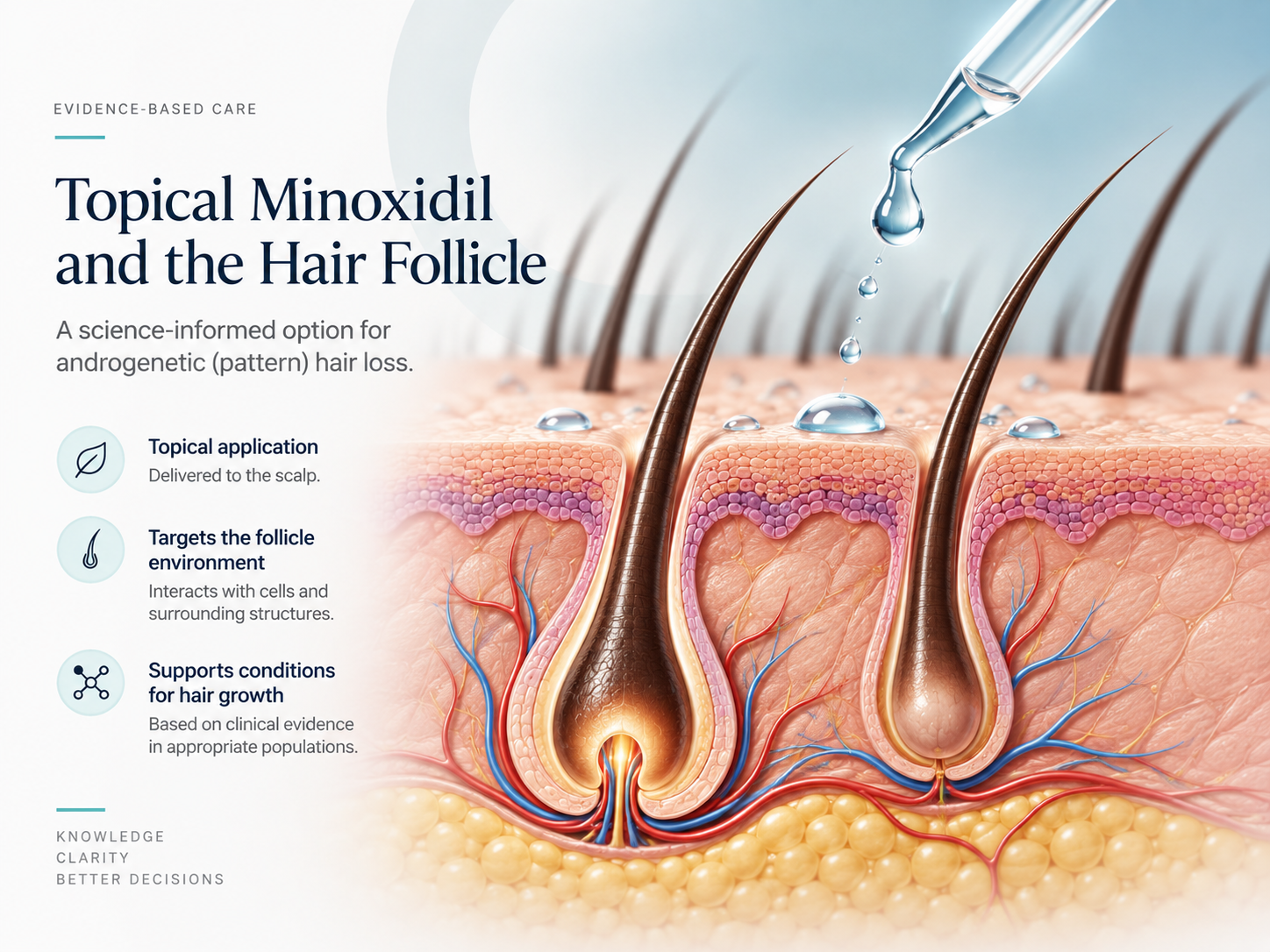
Scientific illustration of topical droplets above a scalp cross-section with hair follicles.

What the Evidence Supports

Randomized trials, systematic reviews and evidence-based guidance show that topical minoxidil can improve hair-growth outcomes compared with placebo in adult androgenetic hair loss. Evidence supports benefit in both men and women, although the studied products, concentrations and outcome measures differ.

Both 2% and 5% topical formulations have supporting evidence. Comparative results and adverse effects vary by population and formulation, and product indications can differ by sex and jurisdiction. The evidence does not establish that 5% is universally superior or that one formulation is preferable for every person.

What Improvement Can—and Cannot—Mean

Studies may measure changes such as hair count, scalp coverage or participant and investigator assessments. An average improvement in a trial does not guarantee visible or cosmetically meaningful regrowth for an individual. Response varies, and some people may experience little or no meaningful benefit.

How It May Work

Topical minoxidil is converted in the hair follicle to an active form called minoxidil sulfate. Several follicular and cellular effects have been proposed, including changes in hair-cycle activity. However, the exact mechanism responsible for hair growth is not fully established, and no single proposed pathway should be treated as definitive.
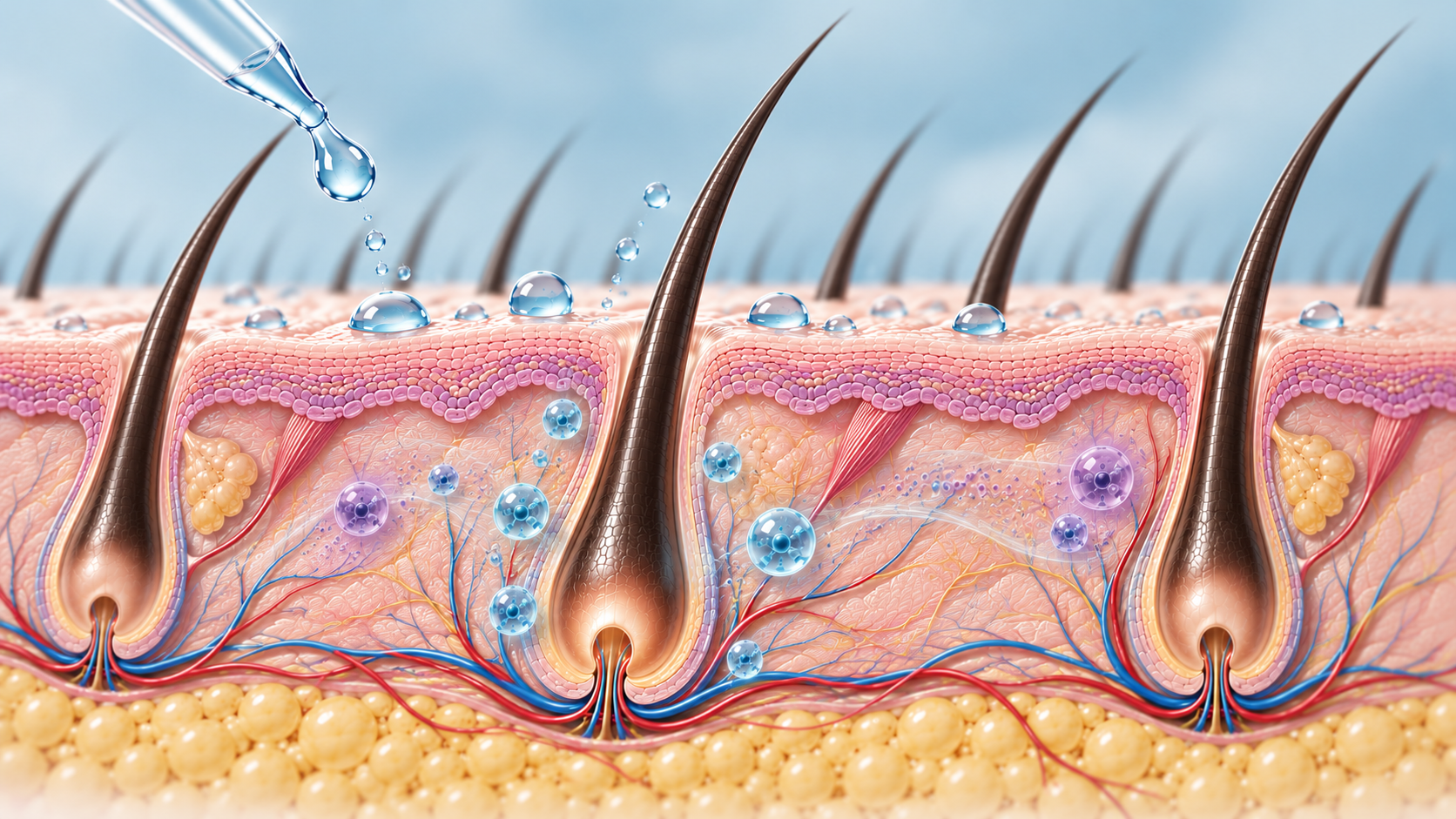
Scientific illustration of topical droplets above a scalp cross-section with hair follicles and surrounding cellular activity.

When Change May Become Noticeable

Change may become noticeable after several months. Response is commonly evaluated around six months, but this is not a guaranteed response time or a universal deadline. Timing and degree of change vary between individuals.

Why Continued Use Matters

Continued use is generally needed to maintain benefit acquired with topical minoxidil. After treatment is stopped, that benefit is typically lost over subsequent months and the underlying pattern of hair loss continues. This should not be interpreted as an exact discontinuation timeline for every person.

Early Shedding: What We Actually Know

A temporary increase in shedding can occur during the early treatment period, but it is not universal. Evidence about its frequency, timing and meaning is limited and comes mainly from observational studies. Early shedding should not be presented as proof that treatment is working or as a reliable predictor of response. Persistent, worsening or otherwise concerning shedding should be assessed in context rather than assumed to be a treatment effect.

Safety & Tolerability

Commonly reported effects are local. These can include scalp irritation, dryness, scaling and pruritus. Irritant reactions may relate to minoxidil, the vehicle or both; allergic contact dermatitis can also occur but should not be assumed from irritation alone. Some solution vehicles contain propylene glycol, which can contribute to irritation, while formulations differ in their ingredients and tolerability.

Unwanted facial or body hair can occur, particularly when product is transferred beyond the intended scalp area. Systemic effects appear uncommon with correct topical use, but rare events are difficult to quantify and product warnings should still be followed. Concerning symptoms should prompt appropriate professional advice.

Important Use Boundaries

Product instructions and regulatory indications vary by formulation, sex and jurisdiction. This profile does not provide individualized dosing instructions. Current safety guidance treats pregnancy and breastfeeding as precautionary boundaries because safety data are limited; this is not a quantified claim of fetal risk.

Professional assessment is appropriate when the diagnosis is uncertain, hair loss is patchy, the scalp is significantly inflamed or painful, scarring is possible, or unexplained shedding is persistent or worsening. These are assessment boundaries, not emergency-triage rules.

Decision Context

Topical minoxidil is a treatment option, not a diagnostic test. Using it—or responding to it—does not identify the cause of hair loss. A decision about use should begin with a credible understanding of the hair-loss pattern and should account for product instructions, preferences, tolerability and qualified assessment where indicated.

Evidence at a Glance

  • Strongest evidenceAdult androgenetic / pattern hair loss
  • ResponseVaries between individuals
  • TimelineChange may become noticeable after several months
  • MaintenanceContinued use is generally needed to maintain acquired benefit
  • Early sheddingPossible; evidence about timing and meaning remains limited
  • Important limitMinoxidil is not a diagnostic test or universal treatment for hair loss

Evidence Supports

  • Topical minoxidil improves hair-growth outcomes compared with placebo in adult androgenetic (pattern) hair loss.
  • Evidence supports topical minoxidil in both adult male androgenetic alopecia and female pattern hair loss.
  • Both 2% and 5% topical formulations have evidence of efficacy, although comparative results vary by population and formulation.
  • Trial outcomes can include improvements in hair count, scalp coverage, or participant and investigator assessments.
  • Change may become noticeable after several months, with response commonly evaluated around six months and individual variation expected.
  • Continued use is generally needed to maintain benefit acquired with topical minoxidil.
  • Benefit acquired during treatment is typically lost over subsequent months after stopping.
  • A temporary increase in shedding can occur early in treatment, but it is not universal and its timing and meaning remain uncertain.
  • Common adverse effects are predominantly local and can include irritation, dryness, scaling, pruritus, and unwanted facial or body hair.
  • Systemic effects appear uncommon with correct topical use, while product warnings and concerning symptoms still require appropriate attention.
  • Using—or responding to—topical minoxidil does not identify the cause of hair loss.

Evidence Limitations

  • The degree and personal significance of improvement vary between individuals, and some people experience little or no meaningful benefit.
  • Studies use different populations, formulations, durations and outcome measures, limiting direct comparison of results.
  • Statistical improvement in a study does not guarantee visible or cosmetically meaningful regrowth for an individual.
  • Evidence does not establish that 5% is universally superior to 2% or that one formulation is preferable for every person.
  • Product indications and instructions can differ by formulation, sex and jurisdiction.
  • The exact mechanism responsible for hair growth is not fully established; several follicular and cellular effects remain proposed rather than definitive.
  • Response timing varies, and six months is a common evaluation point rather than a guaranteed response time or universal deadline.
  • Early-shedding evidence is mainly observational and does not establish a rigid window, universal occurrence or reliable prediction of response.
  • Many solution formulations contain vehicles such as propylene glycol that can contribute to irritation; tolerability differs between formulations.
  • Trials and reviews are not designed to quantify every rare systemic effect with precision.
  • The established efficacy evidence applies primarily to adult androgenetic/pattern hair loss and should not be generalized to other alopecias.

Evidence Does Not Support

Minoxidil treats every cause of hair loss or shedding.
Evidence for topical minoxidil in adult androgenetic alopecia does not establish efficacy for all diffuse, patchy, inflammatory or scarring hair loss. Treatment choice depends on the underlying pattern and context.
Topical minoxidil guarantees regrowth or stabilization.
Average improvements in trials do not guarantee a clinically or cosmetically meaningful result for an individual, and non-response occurs.
Five percent minoxidil is universally superior or appropriate for every adult.
Comparative efficacy, tolerability, labeling and recommended use vary by population, formulation, sex and jurisdiction.
Early shedding proves that minoxidil is working or reliably predicts response.
Early shedding is not universal. Current evidence is mainly observational and does not establish a rigid timeframe or reliable prognostic meaning.
Response to minoxidil establishes the diagnosis or cause of hair loss.
Minoxidil is a treatment option, not a diagnostic test. Using it—or responding to it—does not identify the underlying cause.

Evidence Confidence

Efficacy direction in adult androgenetic alopeciaHigh
Multiple randomized controlled trials and systematic reviews support improved hair-growth outcomes with topical minoxidil compared with placebo. High confidence applies to this direction of efficacy only; it does not imply a uniform magnitude or guaranteed cosmetically meaningful result.
Magnitude and cosmetic significanceModerate
Average benefit is supported, but outcome measures and effect sizes vary and individual response is not uniform.
Formulation and concentration comparisonsModerate
Both 2% and 5% preparations and different vehicles have relevant evidence, but comparative conclusions depend on population, product and jurisdiction.
Proposed mechanismLimited
Conversion to minoxidil sulfate and several follicular or cellular effects are plausible, but the exact mechanism is not fully established.
Early temporary sheddingLimited
Temporary early shedding can occur, but evidence is mainly observational; frequency, timing and predictive meaning remain uncertain.
Common local tolerabilityModerate-High
Local irritation, pruritus and unwanted hair growth are consistently reported, with formulation and vehicle affecting tolerability.
Rare systemic effectsLimited
Systemic effects appear uncommon with correct topical use, but available studies cannot precisely quantify every rare event.

Evidence Sources

Last Evidence Review